Edited by Urulókë on 2019-3-8 6:43:28 PM UTC Edited by Urulókë on 2019-3-8 6:43:49 PM UTC Edited by Urulókë on 2019-3-8 11:29:17 PM UTC Edited by Urulókë on 2019-3-9 3:02:44 AM UTC
2019-3-8 6:05:01 PM UTC
Amazon Prime Video recently (March 6th and 7th) released the last two updates to their maps they have been teasing as a part of their social media marketing campaign. This is my speculation (and only speculation) on what the maps mean.
There are two distinct timeframes - the first four maps were shown in a progressive release with additional names being added to build anticipation, leading up to "Map 4" as I will refer to it here - this map dates to the Second Age or early Third Age, between S.A. 3320 and perhaps T.A. 1000 covering the timeframe when the Last Alliance of Elf and Men defeat Sauron and Second Age ends, Arwen is born and many other events. The map released on March 7th ("Map 5") dates to S.A. 750 to circa S.A. 1000, when the Númenóreans are just starting to explore and colonize Middle-earth, Eregion is founded by the Noldor, and Sauron is just beginning to stir again. This time frame pretty much exactly matches the reign of Tar-Aldarion, the sixth King of Númenor.
Also of significance, the maps use ALL CAPS for certain locations, which I believe indicates areas of specific interest during these two time frames. I sincerely believe that Amazon is hinting at the plot-lines that the show will cover with this contrivance. Go back and take a closer look at the maps, and you will see what I mean. Some cities are in CAPS, other are not. Some place-names change from ALL CAPS on one map, to Regular Capitalization on the other map. This cannot be in error or coincidence. More on this below for each map.
Finally, there are multiple place-names that only occur in Unfinished Tales, so I think we can definitively say that Amazon has permission to be using material from here (and perhaps other books as well, too early to tell) not available to previous filmmakers.
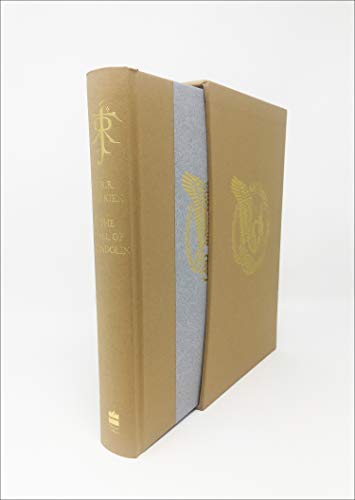
Cover from tolkienbooks.net
Map 4 of Middle-earth from Amazon Prime, used with permission
Map 4
I've dated this map as coming from S.A. 3320 and covering the time-frame of the Last Alliance. This is the earliest the map can be from, as it shows the city of Osgiliath. From Appendix A of The Lord of the Rings,
"The last leaders of the Faithful, Elendil and his sons, escaped from the Downfall with nine ships, bearing a seedling of Nimloth, and the Seven Seeing-stones (gifts of the Eldar to their House); and they were borne on the wind of a great storm and cast upon the shores of Middle-earth. There they established in the North-west the Númenórean realms in exile, Arnor and Gondor. Elendil was the High King and dwelt in the North at Annúminas; and the rule in the South was committed to his sons, Isildur and Anárion. They founded there Osgiliath".
The Downfall of Numenor happens in S.A. 3319, and the founding of the kingdoms of Arnor and Gondor in S.A. 3320 (both from LOTR Appendix B, "The Tale of Years"). So the map cannot be from before S.A. 3320. It is hard to put an upward bound on the map. Dol Guldur is not labeled, which was made Sauron's fortress around Third Age 1050.
Other interesting tidbits about this map: (all dates from LOTR Appendices unless otherwise noted)
All seven locations of the Palantíri ("Seven Seeing stones") are shown. Only Orthanc is in CAPS, so my guess is Amazon is hinting that the stones will be peripheral rather than central.
Mordor was chosen by Sauron as his stronghold circa S.A. 1000. He started contstructing Barad-dûr at that time, and completed it around S.A. 1600.
Pelargir the city was build in S.A. 2350. As it merits being written in CAPS, I am flagging this as likely a plot driving location.
It seems quite likely that the Last Alliance could be a major season-driving event for Amazon. Also, since Minas Ithil is still labeled on this map, it likely dates it to before Third Age 2002. (Aragorn was born T.A. 2931, so it seems incredibly unlikely that this map covers a "Young Aragorn".
Map 5 of Middle-earth from Amazon Prime, used with permission
Map 5
The presence of Ost-In-Edhil on the map is quite helpful. This city was founded in S.A. 750, so the map cannot be older than this. Also, it was destroyed in S.A. 1697, so that likely puts a limit on the age of the map from that side as well.
Also of note, there is nothing in what will eventually become known as Mordor - Barad-dûr is not started, and Orodruin is not yet named (the Fire-mountain). As Sauron moved here in S.A. 1000, that is likely the latest this map would date from (though Sauron kept his plans hidden for a long time, so it is possible that the cartographer was not aware of what was going on there).
One other date-able feature on the map are Eregion, overrun and destroyed in S.A. 1697 as well. We know the map must be in the Second Age, as none of the Númenórean settlements from late SA are present (Osgiliath, Minas Anor, Annûminas, etc.). Also missing is Imladris, founded in S.A. 1697.
I am fairly confident with the 1000 date, but with all of the other clues I believe the map is strongly hinting that it is based on the life of Tar-Aldarion, sixth king of Númenor. He was born in S.A. 700 and lived until S.A. 1098, and ruled Númenor from S.A. 883 until 1075. He was a mariner and sailed often from his home island to Middle-earth, he founded the port city of Lond Daer (one of the landmarks chosen by Amazon to put on the map), traveled as far inland as Tharbad (not shown on Amazon's map, but located very closely to Nîn-in-Eilph, which merited being capitalized). He was a good friend of Gil-Galad in Lindon (also a region of much note on the map). See Appendix D of Unfinished Tales for a long discourse on Lond Daer and Aldarion, and the deforesting of Middle-earth. Eryn Vorn (also capitalized) was the peninsula where the "natives" fled from the Númenóreans as they lost their lands.
Also of note (and possible subject matter intertwined or in a separate season), the Mountains of Moria are capitalized - Caradhras, Fanduidhol and Celebdil. Interestingly, they are all given their Sindarin names, not Dwarvish. Also in capitals is Nanduhirion, also known as Dimrill Dale - site of a large battle in the Third Age, not mentioned in the Second Age. Something important is afoot in this region!
Also capitalized:
Gundabad (Dwarven fortress, taken over by Orcs in the "mid-Second Age")
Ninglor (a river near Moria)
Ethir Anduin (mouth of the Anduin river) - Galadriel and Celeborn dwelled in this area in the SA, before moving northward)
Morthond (another elvish settlement in the SA, becomes Dol Amroth in the Third Age)
Tolfalas (an island)
And of course, pretty much all of Númenor. Clearly the island will feature heavily in the Amazon series, at least with the season(s) dealing with the time frame of Map 5.
It really feels like Galadriel will feature as many sites on the map are mentioned in conjunction with her in Unfinished Tales, along with the rise of power of Sauron (who re-emerges after defeat in the First Age around S.A. 500). The rings of power are not forged until circa S.A. 1500, with the one ring being forged S.A. 1600. It is possible these events could fit into the timeline of the map, if we assume that Barad-dûr is hidden and not yet known widely.
Also, as should be clear from all of the above, Unfinished Tales is being referenced heavily and a lot of information on the Amazon maps only appears there - not in the Appendices of Lord of the Rings. This seems to clearly indicate that Amazon has the rights to at least large portions of Unfinished Tales.
So, what are your thoughts on the map? I found two inconsistencies that go against what Tolkien wrote and had on his maps (which I have passed on to Amazon). I think in writing this up I found a third, but I want to confirm more details. Can you find any? All of mine are very minor - for the vast majority of items, Amazon really appears to have gotten these maps accurate! I even thought I had caught a bigger error (naming the river Angren), but in reading up I found Tolkien's own notes saying that actually was the correct Elvish name for the river Isen (found, of course, in Unfinished Tales.)
One small side note that I was talking about over on Twitter and forgot to include here - I think it is significant that the Second Age map (5) has "Khazad-Dûm" on it, and the Third Age (ish) map (4) has "Moria". Perhaps another indicator of what is to come in the TV show with the fall of the Dwarven city.
And another thought from yesterday - Map 5 (Second Age) is much more worn looking than Map 4. Does this indicate that the Second Age material will be intermixed (flashbacks?) with other material? I hope not! I would love to see a whole season or more dedicated to the Aldarion epoch.
And... for those deeply interested - CAPS changes made between the two maps:
Nîn-in-Eilph. All CAPS on Map 4 (Third Age), not on Map 5 (Second Age). Also called Swanfleet, translates as "Waterlands of the Swans". Events take place near here in the Third Age (Fell Winter of TA 2911, Great Floods of TA 2912 wipe out city of Tharbad.) (Note - Amazon has "In" capitalized on Map 5, which I believe is in error).
Umbar. Region name is capitalized on Map 5 (Second Age). Changes to city name on Map 4 (Third Age), not all CAPS. Lots happens here in the Second Age. In SA 2280 the Númenóreans make a great fortress with this name (so, close to the timeframe of Map 4, not map 5).
Ethir Anduin. All CAPS on Map 5 (Second Age). Galadriel and Celeborn lived in this area in this timeframe. Not all caps on Map 4 (Third Age).
Outside of promotion of the planned series has anything at all come to public light (legal document leaks etc) in regard to what adaptation rights Amazon has actually bought? Talk of UT rights is very interesting. And I suppose one should always have wondered what The Tolkien Estate was possibly discussing when they don't own the adaptation rights to H + LotRs. I'm sure the license to adapt is time-limited; wonder how long Amazon have to knock out the proposed five+ series they're talking about...
Also, any gossip about them consulting (either now or going forward) with known Tolkien Scholars?
Very nice topic, I like it! Looking forward to the Amazon series as well.
I've checked map 5 and here are some of my initial thoughts:
0. Why Númenor and not Númenórë? Other names are elvish.
1. Romenna -The port stood on the south side of the Firth of Rómenna which opened onto the Bay of Rómenna and then onto the Sea. On Amazon's map, Romenna is positioned on the north side.
2. Why is there a huge sign for Meneltarma and much smaller for the whole region of Mittalmar? Mittalmar is a whole region in which Meneltarma is positioned.
3. Why is there a whole mountain range in the vicinity of Meneltarma? There were five low ridges, there wasn’t any mountain range in Mittalmar.
Unfinished Tales, page 166: ‘’ The base of the Menetarma sloped gently into the surrounding plane ... five long low ridges outwards in the direction of the five promontories of the land; and these were called Tarmasundar, the Roots of the Pillar. ‘’
3. What is that river and bay in the south of Hyarnustar?
Except for Siril nad Nundunie ‘’ all others... were short and swift torrents hurrying to the sea’’ (Unfinished Tales)
4. Where are the great woods of Andustar?
Unfinished Tales, page 167 ‘’much of the southerly part of the Andustar was fertile, and there also were great woods, of birch and beech upon the upper ground, and in the lower vales of oaks and elm’’
They put Fragrant Trees near Eldalonde and great woods of Hyarrostar which is very nice.
5, What are those mountains in Forlindon exactly? I can’t recall any mountain range west of Ered Luin.
5. I guess Nîn-in-Eilph and not Nîn-In-Eilph
6. This one is just for funsies. In a manuscript composed by Tolkien sometime after The Lord of the Rings, Lórinand is said to be a Nandorin name, meaning "valley of gold" (containing the "Elvish word meaning 'golden light'"). However, Christopher Tolkien notes that in a later manuscript the name Lórinand was reconceptualized as "a transformation, after the introduction of the mallorns, of a yet older name Lindórinand ‘’Vale of the Land of the Singers’’" So, Lindórinand" was transformed into Lórinand after the introduction of the mallorns which gave the name to the Valley of the Gold. It was Tar-Aldarion who gave Mallorn nuts to Gil-Galad who in turn gave them to Galadriel who planted them in Lindórinand. It took some time for the mallorn trees to grow to the valley of gold (Lórinand).
So if we are talking about the early period of the rule of Tar Aldarion there should maybe be Lindórinand on the map, not Lórinand. As I don’t know the exact time frame maybe it is all right.
Lokki wrote: Very nice topic, I like it! Looking forward to the Amazon series as well.
I've checked map 5 and here are some of my initial thoughts:
0. Why Númenor and not Númenórë? Other names are elvish.
From Unfinished Tales p. 438: Númenor (In full Quenya form Númenórë. )
I would think both to be acceptable.
1. Romenna -The port stood on the south side of the Firth of Rómenna which opened onto the Bay of Rómenna and then onto the Sea. On Amazon's map, Romenna is positioned on the north side.
UT p. 168 says "Aldarion was much loved by Vëantur his mother’s father, and he dwelt often in Vëantur’s house on the southern side of the firth of Rómenna." Firth refers to the inlet. Perhaps the house was across the bay from the city. But, the map in UT clearly shows Rómenna to be on the southern coast of the inlet laid in between p. 168 and 169. Good catch!
2. Why is there a huge sign for Meneltarma and much smaller for the whole region of Mittalmar? Mittalmar is a whole region in which Meneltarma is positioned.
Artistic license? Meneltarma is a pretty big mountain as they have drawn it.
3. Why is there a whole mountain range in the vicinity of Meneltarma? There were five low ridges, there wasn’t any mountain range in Mittalmar.
Unfinished Tales, page 166: "The base of the Menetarma sloped gently into the surrounding plane ... five long low ridges outwards in the direction of the five promontories of the land; and these were called Tarmasundar, the Roots of the Pillar."
Again probably artistic license. If you take the scale as drawn to be correct, those five ridges are not as tall as the trees to their southeast on the island.
3. What is that river and bay in the south of Hyarnustar?
Except for Siril and Nunduinë "all others... were short and swift torrents hurrying to the sea" (Unfinished Tales)
I'll give the cartographer a pass on this one - clearly, an island such as this would not have solely two rivers flowing to the sea. The current cartographer has one in the northeast as well. They are drawn as much shorter than the other two rivers.
4. Where are the great woods of Andustar?
Unfinished Tales, page 167 ‘’much of the southerly part of the Andustar was fertile, and there also were great woods, of birch and beech upon the upper ground, and in the lower vales of oaks and elm’’
They put Fragrant Trees near Eldalonde and great woods of Hyarrostar which is very nice.
Eldalondë is in Andustar, so the woods drawn on Amazon's map are in the southerly portion of that region.
5, What are those mountains in Forlindon exactly? I can’t recall any mountain range west of Ered Luin.
You are correct, there aren't any on the Unfinished Tales map or The Lord of the Rings map. I am guessing the cartographer didn't want a big blank area on the map.
5. I guess Nîn-in-Eilph and not Nîn-In-Eilph
Typo on my part! I will fix. Also I will ask Amazon to fix.
6. This one is just for funsies. In a manuscript composed by Tolkien sometime after The Lord of the Rings, Lórinand is said to be a Nandorin name, meaning "valley of gold" (containing the "Elvish word meaning 'golden light'"). However, Christopher Tolkien notes that in a later manuscript the name Lórinand was reconceptualized as "a transformation, after the introduction of the mallorns, of a yet older name Lindórinand ‘’Vale of the Land of the Singers’’" So, Lindórinand" was transformed into Lórinand after the introduction of the mallorns which gave the name to the Valley of the Gold. It was Tar-Aldarion who gave Mallorn nuts to Gil-Galad who in turn gave them to Galadriel who planted them in Lindórinand. It took some time for the mallorn trees to grow to the valley of gold (Lórinand).
So if we are talking about the early period of the rule of Tar Aldarion there should maybe be Lindórinand on the map, not Lórinand. As I don’t know the exact time frame maybe it is all right.
Good luck Amazon!!! Make us proud!!!
Good catch! I am being pulled three different directions, can you provide sources for this last bit (where Christopher says this about Lórinand). I will do some reading as soon as I can.
In your CAPS comment, you mention that Nîn-in-Eilph is “also called Swanfleet.” Strictly speaking, you’re right: Christopher Tolkien, Hammond and Scull, and Karen Fonstad all have called the fens “Swanfleet.” And further, both CT and H&S said that Pauline Baynes, who put Swanfleet as the lower portion of the river “misunderstood” (CT) and “erroneously” (H&S) marked it thus.
However:
1. Baynes made her map under Tolkien’s guidance, and he did not correct this when given the opportunity.
2. Tolkien chose the name Swanfleet, and surely knew that to fleet means “to flow, to pass swiftly, to vanish” — all of which the river does, and the fens do not.
3. As you noted, Tolkien glossed Nîn-in-Eilph as “the Waterlands of the Swans,” not as “Swanfleet.”
4. Tolkien wrote on the map he annotated for Baynes that “the upper part of the Swanfleet is called Glanduin.”
5. In the same note, Tolkien instructed Baynes to “apply Swanfleet … to lower part & if possible place R. Glanduin near mountains.”
6. In “The Rivers and Beacon-hills of Gondor,” Tolkien writes “it is called the Swanfleet river ..., simply as being the river that went down into Nin-in-Eilph, ‘the Water-lands of the Swans’. Unfinished Tales, 264–5.
This basically, was the conclusion of the paper I gave at the Tolkien Anniversaries symposium put together by Brad Eden right before the International Congress of Medieval Studies in Kalamazoo, Michigan, in 2017 — extravagantly titled “The river Swanfleet: A journey from the Misty Mountains to flat fenlands and half-way back again; or, How the discovery of Tolkien’s annotated map of Middle-earth by Blackwell’s Rare Books in Oxford extricates Pauline Baynes’s cartographic reputation from the marsh of Nîn-in-Eilph.”
So, perhaps more precisely, one could say that Nîn-in-Eilph is miscalled Swanfleet.
I really enjoyed your post, by the way, and now realize that perhaps I should have been paying these Amazon maps a little more attention!
Thanks for sharing ErikMH, I think you are absolutely correct. Looking at the annotated map, it is clear that Tolkien meant for the marshes to be at the "junction of Swanfleet and Hoarwell".
Another interesting point raised by @Yaviendil on Twitter:
It shows that they have far more access to lore material. Not just Unfinished Tales, but also Vinyar Tengwar, an Elvish Linguistics Paper. See Côf Belfalas. https://eldamo.org/content/words/word-485109463.html
As far as my digging around can see this evening, the only use of Côf is in this VT referenced here. Good catch!







 But, the map in UT clearly shows Rómenna to be on the southern coast of the inlet laid in between p. 168 and 169.
  Good catch!


 10
10