Edited by Urulókë on 2020-12-1 10:53:26 PM UTC Edited by Urulókë on 2020-12-1 10:56:02 PM UTC
2020-12-1 9:33:15 PM UTC
Scull & Hammond have a brief entry in their Reader's Guide (2017) in the "Societies and Clubs" section, pages 1231-2, where they note that the club was mainly for Oxford and Cambridge Dons to gather a few times a year to dine. There is a very brief note in the Chronology for a club meeting on June 2, 1951.
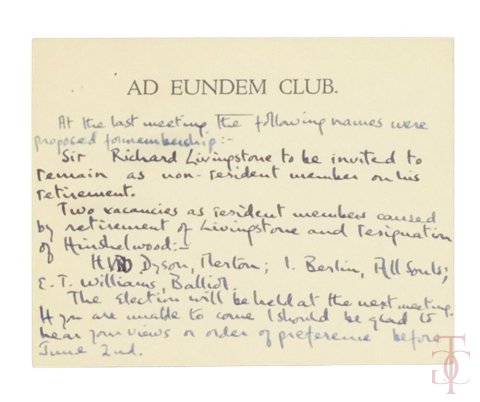
Johnson Rare Books have just listed a bit of ephemera that adds a bit more colour to this event, including an interesting tidbit that fellow Inkling Hugo Dyson was nominated to join the club.
This unsigned, undated card was sent to fellow member Julian S. Huxley, and says that Lord David Cecil will be the guest of honor for the June 2 dinner, and that an election to fill two vacant seats in the club will take place during this meeting. The nominated individuals are HVD Dyson (Merton), Berlin (All Souls), and E.T. Williams (Balliol). Also noted is that Sir Richard Livingstone will be invited to remain a non-resident member upon his retirement. Also included in the listing is a response from Huxley back to Tolkien, dated 31 May 1951, where he apologizes for not being able to attend.
Sorry, but no, that is not "clearly in Tolkien's handwriting". None of this looks like any of Tolkien's handwriting that I've seen (and I've seen a great deal of it).
Sorry, but no, that is not "clearly in Tolkien's handwriting". None of this looks like any of Tolkien's handwriting that I've seen (and I've seen a great deal of it).
Certainly I would not dispute your expertise! My apologies, and I have updated the original article to remove the claims that this was Tolkien's handwriting.
Hopefully the biographical information of who attended and the Hugo Dyson association are still interesting, at least.
Agreed with Aelfwine that the handwriting isn't Tolkien's. He was merely the point of contact for the club, as secretary for the Oxford branch. "I. Berlin" was Isaiah Berlin, CBE, a Latvian by birth, Fellow of All Souls, Oxford, later a professor of social and political theory; and "E.T. Williams" was Brigadier Edgar Trevor Williams, Fellow of Balliol College, an editor on the Dictionary of National Biography, and an architect of the Allied victory at El Alamein. Those must have been some dinners, with members (or prospective members) like these.








 30
30