Edited by Stu on 2021-12-5 7:35:48 PM UTC Edited by Stu on 2021-12-5 7:37:58 PM UTC Edited by Trotter on 2021-12-16 4:27:11 PM UTC Edited by Trotter on 2023-12-3 12:59:29 PM UTC Edited by Trotter on 2024-5-5 7:11:21 AM UTC
2021-12-3 4:10:59 PM UTC
Lot 886
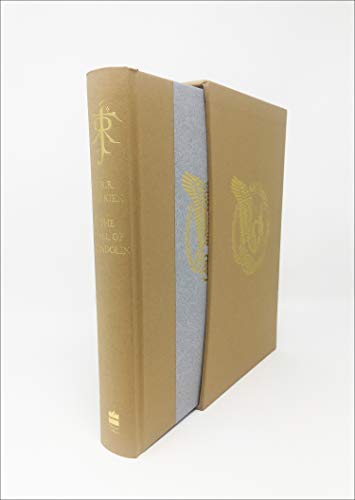
Tolkien (J.R.R.) Lord of the Rings: The Fellowship of the Ring, 13th impression, 1963; The Two Towers, 10th impression, 1963; The Return of the King, 10th impression, 1963, folding map at end of each, bookplates of Suzanne Eward, all edges gilt, original black cloth, spines lettered in gilt, 8vo, together with The Hobbit, 5th impression, 1970, and The Silmarillion, 1st edition, 1977, with two letters to Suzanne Eward from J.R.R. Tolkien, one a 2 pp. autograph letter dated April 23 1972 on Merton College Oxford headed paper donating the above Lord of the Rings and Hobbit to Gloucester Cathedral Library, "I protest that your letter seemed to me neither an impertinence nor a presumption, but a very high compliment. All the more welcome as coming from Gloucester. My love is given above all other regions to the 'West Midlands', in which I lived as a child. My mother belonged to a Worcestershire family; my wife to one of Staffordshire, though she was actually born in Gloucester, and later lived for some years in Cheltenham... I will certainly present copies of any of my works which the Dean and Chapter think worthy of Including in their library. I suggest that copies of each of the 3 vols of the Revised Edition would be more suitable than the later 1 vol. edn. on India paper. Also that this should be accompanied by a copy of The Hobbit: in the reprint of the edn. with coloured illustrations (which was mostly burned up in the Blitz of London)... With regards to signature, to avoid the trouble and expense of postages I usually send inscribed labels of which I enclose a specimen... with best wishes, yours sincerely J.R.R. Tolkien", with the signed label, inscribed "Presented to the Gloucester Cathedral Library by J.R.R. Tolkien" folds and a few minor spots to the letter; the other letter a 1 pp. typed letter signed, dated 5th May 1972, stating that he had ordered from publishers Allen & Unwin the three volumes of Lord of the Rings and The Hobbit to be sent to the Dean and Chapter of Gloucester Cathedral Library, plus four signed labels (not present here), and a postscript "I am sorry that it is not possible to find copies of the first editions for presentation", folds and a few spots, both letters contained in the original envelopes
(Qty: 7)
The recipient of the books and letters was Suzanne Mary Edward(sic), former Librarian and Keeper of the Muniments at Gloucester Cathedral and Wells, and latterly at Salisbury Cathedral.
You should always exercise good judgement and perform appropriate due-diligence when acquiring signed items to ensure that you are satisfied with the provenance and integrity of any item you bid on.
Tolkien (J.R.R.) The Lord of the Rings: The Fellowship of the Ring, 5th impression, 1956; The Two Towers, 2nd impression, 1955; The Return of the King, 2nd impression, 1955, folding map at end of each, previous owner signature to Fellowship front endpaper, a couple of small stains to one or two endpapers, top edges red, original red cloth gilt, dust jackets, some fading to spine lettering, a few chips, tears and stains, 8vo
Auction house estimates have very little to do with what the auction house believes the item will sell for (and there are various reasons for that which have been discussed before). I don't know why we are even including them in the posts. The *only* number that actually matters is the final selling price including fees. The estimate is broadly-speaking meaningless.
Auction house estimates have very little to do with what the auction house believes the item will sell for (and there are various reasons for that which have been discussed before). I don't know why we are even including them in the posts. The *only* number that actually matters is the final selling price including fees. The estimate is broadly-speaking meaningless.
I broadly agree. I find it useful to note the estimates for three reasons - First, I personally like to have the historical information of estimates vs. final selling value (useful to show people how widely off they have been in the past, as you note above). Secondly, when a lot does not sell, knowing the estimate gives a good indication of the opposite (estimate was too high and didn't attract any bidders). Third, and related to the second, is that most auction houses will not take bids less than half of the lower estimate - they and the seller would rather the item go unsold.
Auction house estimates have very little to do with what the auction house believes the item will sell for (and there are various reasons for that which have been discussed before). I don't know why we are even including them in the posts. The *only* number that actually matters is the final selling price including fees. The estimate is broadly-speaking meaningless.
Auction house estimates have very little to do with what the auction house believes the item will sell for (and there are various reasons for that which have been discussed before). I don't know why we are even including them in the posts. The *only* number that actually matters is the final selling price including fees. The estimate is broadly-speaking meaningless.
If anything they are useful to see what the auction house and seller think is the bottom end of the market for a particular item, are they not?
I don't think so. All that happens is that we post up auction and then post our own comments that we think it is low. That is clearly sending an inflationary message. Given we seem set on publishing auctions, I think we should do it in the most neutral way possible, and effectively saying "It'll go for more than this" against every auction is - IMHO - harmful. We can discuss this in the Shirriffs forum, I guess.
"saying 'It'll go for more than this' against every auction is - IMHO - harmful."
"Harmful" how, exactly? To whom? If someone is willing to pay more than someone else's estimate, whom does that "harm"? So long as the transaction is in no way coerced, why do you care? (I mean, if you disagree with a valuation, you can certainly say so. But to attribute "harm" to another's valuation of something seems to me censorious.) NOTHING has any intrinsic value (except human life, which is infinite); worth is otherwise determined by what someone somewhere is willing to pay (though only for that person).
"saying 'It'll go for more than this' against every auction is - IMHO - harmful."
"Harmful" how, exactly? To whom? If someone is willing to pay more than someone else's estimate, whom does that "harm"? So long as the transaction is in no way coerced, why do you care? (I mean, if you disagree with a valuation, you can certainly say so. But to attribute "harm" to another's valuation of something seems to me censorious.) NOTHING has any intrinsic value (except human life, which is infinite); worth is otherwise determined by what someone somewhere is willing to pay (though only for that person).
Yes, you don't need to repeat yourself about intrinsic value. No one mentioned intrinsic value - we are talking about market value.
It is harmful to collectors who would like to have the most collecting opportunities open to them. I would have thought my point was fairly obvious. It is harmful because it creates a false sense that there is constant value increase, when actually what is happening is there is constant mischief by valuers (for a variety of reasons).
It is also well documented that markets are driven by sentiment, perception and (positive and negative) feedback loops.
The other main reason for publishing the Estimate is that you do not know if a reserve price has been set, as Auction Houses do not disclose this. The Estimate is a good indication of what that may be if it has been set.
It is also difficult for an valuer to come up with an Estimate that is reflected in the actual sold price. I like guessing if the estimate is off the mark for the item.








 29
29