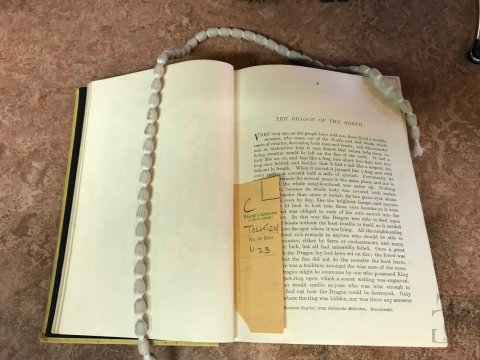
[Update] I've been asked to add a bit of additional information for the book pictured: it is The Yellow Fairy Book (ed. Andrew Lang)
From the article link above:
I contacted the Bodleian’s Tolkien Archivist, Catherine McIlwaine, who was able to confirm this. She explained that Tolkien looked at the book ahead of giving his famous Andrew Lang lecture at the University of St Andrews on 8th March 1939.
[...]
Library records show that Tolkien consulted the book, among others, on the 27th February 1939.
[...]
At 10:30am Tolkien requested to see: The Olive Fairy Book, ed. by A. Lang (1907) The Book of Dreams and Ghosts, by A. Lang (1897) The Lilac Fairy Book, ed. by A. Lang (1910) The Green Fairy Book, ed. by A. Lang (1892) Favourite Fairy Tales (Fairy tales retold) 1907 The Brown Fairy Book, ed. by A. Lang (1904) The Crimson Fairy Book, ed. by A. Lang (1903) The Violet Fairy Book, ed. by A. Lang (1901) The Yellow Fairy Book, ed. by A. Lang (1894)
Later on, at 11:30am, he requested: Fairy Gold, a book of old English Fairy Tales chosen by Ernest Rhys (1907) The Secret Commonwealth of Elves, Fauns and Fairies (compiled in 1893) by Robert Kirk Essays in Little by A. Lang (1891) Perrault’s Popular Tales, ed. by A. Lang (1888) The Magic Ring, and other stories from the Yellow and Crimson Fairy Books, ed. by A. Lang (1906) English Fairy and other folk tales, selected and edited by Edwin Sidney Hartland (1893)
[...]
The slip we found was left in the book at the beginning of The Dragon of the North a story about a courageous youth who defeats a man-eating dragon. He manages this feat with a magic ring, stolen from a witch maiden. Amongst many of its powers, if placed on the third finger of the left hand, it turns the wearer invisible. In the end, the ring is too powerful, and the youth learns that ‘ill-gotten gains never prosper’ when the witch retrieves the ring and punishes him for his deception. There is a eucatastrophe- the term Tolkien coined to describe happy endings in Fairy Tales- as the youth is rescued and made king.
I realize from the original blog post that it’s been verified that Tolkien checked out (more accurately:accessed) this book in 1939. But there were also some discrepancies there (e.g. reader’s seat number). While possible, it seems much more likely to me that this book was checked out again later by Tolkien, or even by Christopher Tolkien (notice the big “C”), than that this slip has stayed in the book ever since 1939. Just sayin’.
You are correct, "accessed" would be the right word. I am not at all sure the "C" is for Christopher though, that seems like a bit more of a stretch than other speculations in the article.
All in good fun. This article does make me wonder, though: clearly the author was able to see what books he accessed on that day. I would love for someone to go through and pull out all of the book he ever accessed - that would be quite an interesting list to correlate with everything else! I had no idea that this was possible, so I am quite intrigued.







 20
20