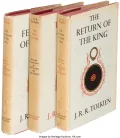
The Fellowship of the Ring. Being the First Part of The Lord of the Rings. London: George Allen & Unwin Ltd, 1954. First edition, first impression, with signature "4" and straight lines of type on page 49. Octavo. 423, [1, colophon] pages. In-text map of the Shire and folding map tipped to recto of rear free endpaper, both by Christopher Tolkien; three in-text illustrations by J. R. R. Tolkien. Publisher's red cloth, spine lettered in gilt; all text block edges trimmed, top edge stained red; original dust jacket printed in black, red, and gold on light gray paper. Spine ends gently pushed and showing some mild wear; gilding at spine tarnished; hint of discoloration along joints; minor wear along top and bottom edges of boards; trace of dust-soiling along top edges. Faint yellowing to endpapers and text block; age discoloration and foxing to endpapers; some staining to bottom and fore-edge of text block; a few faint instances of mild, marginal staining at interior; trace of foxing to first and last few leaves; creasing to upper corners of a couple of leaves; small bump a bottom edge of text block resulting in small nicks to lower edges of a handful of pages. Jacket nicked at spine and flap fold ends; sunning and a bit of staining to spine panel and flap folds; light rubbing and a couple of spots of soiling to front and rear panels; rumpling and mild discoloration to top edges of flaps. Very good. Hammond and Anderson A5 i.
The Two Towers. Being the Second Part of The Lord of the Rings. London: George Allen & Unwin Ltd, 1954. First edition, first impression. Octavo. 352 pages. Folding map by Christopher Tolkien tipped to recto of rear free endpaper. Publisher's red cloth, spine lettered in gilt; all text block edges trimmed, top edge stained red; original dust jacket printed in black, red, and gold on light gray paper. Spine slightly skewed; spine ends gently rolled with a trace of wear; hint of minor soiling to boards; light wear along bottom edges. Endpapers and text block softly yellowed; minor age discoloration to endpapers; bookseller's ticket at rear pastedown; evidence of a few labels removed at corners of rear pastedown; a few surface scratches at fore-edge of text block. Light edge wear to jacket; spine panel and flap folds sunned; wear along folds; front and rear panels thumbsoiled; price-clipped. Near fine. Hammond and Anderson A5 ii.
The Return of the King. Being the Third Part of The Lord of the Rings. London: George Allen & Unwin Ltd, 1955. First edition, first impression. Octavo. 416 pages. Folding map by Christopher Tolkien tipped to recto of rear free endpaper. Publisher's red cloth, spine lettered in gilt; all text block edges trimmed, top edge stained red; original dust jacket printed in black, red, and gold on light gray paper. Spine leaning; spine ends pushed and showing a bit of wear; gilding at backstrip tarnished; hint of discoloration along joints; trace of wear along bottom edges of boards. Mild yellowing to endpapers and text block; hint of age discoloration and moderate foxing to endpapers; minor drip staining to top and fore-edge of text block. Jacket nicked at spine and flap fold ends; mild sunning to spine panel and flap folds; some general, minor staining; light edge wear resulting in some soft creasing along edges of front and rear panels. Near fine. Hammond and Anderson A5 iii.
Minimum bid $4000 ($5000 with 25% buyer's premium) [Update] Sold for $19,000 ($23,750 including Buyer's Premium)
''The Fellowship of the Ring. Being the First Part of The Lord of the Rings. London: George Allen & Unwin Ltd, 1954. First edition, first impression, with signature "4" and straight lines of type on page 49. ''
garm wrote: ''The Fellowship of the Ring. Being the First Part of The Lord of the Rings. London: George Allen & Unwin Ltd, 1954. First edition, first impression, with signature "4" and straight lines of type on page 49. ''
Oops!
Well, all of the various states are first impressions...
but even so - I believe the signature "4" and straight line has been shown to be the first state (I have added bold to the following details taken from tolkienbooks.net):
The first state is the text as originally set and proofed - the lines of text are straight, i.e. they do not sag or step down, and there is no signature mark '4' in the lower left hand corner of the page. In the second state, the signature mark is still absent, but the text is now damaged and steps down part of the way along the line - it is most obvious near the bottom of the page. The third and final state still has the damaged text, as well as a signature mark '4' in the bottom left corner of the page.
A fourth state (preceding state 1) has been proposed in The Tolkien Collector Issue 22, but has not been seen - Undamaged text with the signature mark '4' present.
A small scale survey by Steven M. Frisby found 8 out of 10 copies checked had the third state of the defective text. The other two states appeared in just one of the 10 copies checked.
Hammond states that variant 3 is the earliest state and that variant 1 is the latest. This statement was based on the assumption that the damaged text would have been picked up by the printers and corrected. This was not the case - all later impressions included the damaged text, although the signature mark was removed after the second impression. Wayne Hammond noted this misinterpretation in Issue 11 of The Tolkien Collector.
The first edition sets in similar condition have been selling in excess of what has ben recorded in this auction and I don’t think the bidders cared much about the variation in “states.” I believe this was sold for less because it was sold at Heritage?
The previous sales on Bonham and other major auction houses far exceed this hammer price.
The_Antiquarian wrote: The first edition sets in similar condition have been selling in excess of what has ben recorded in this auction and I don’t think the bidders cared much about the variation in “states.” I believe this was sold for less because it was sold at Heritage?
The previous sales on Bonham and other major auction houses far exceed this hammer price.
I think it probably has more to do with a softening of prices at the upper end over the last year or two. That's just anecdotal observation, though.
I assume this will continue as the lower-end market will collapse (for obvious reasons) over the next few months, so it seems likely that this will have a knock-on effect.
Worth saying, that very specific and unusual states aside, near fine condition 1/1 LOTRs are not THAT scarce. They have the illusion of scarcity because they have been relatively expensive for a couple of decades.








 0
0