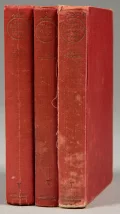
Lot 678 TOLKIEN, J R R THE LORD OF THE RINGS; THE FELLOWSHIP OF THE RING; THE TWO TOWERS; THE RETURN OF THE KING London, George Allen & Unwin Ltd, 1954, 1954, 1955, first edition/first state of each of the three books, original publisher’s red cloth, some light marks primarily to vol 1, some general wear to extremities, later ink ownership inscriptions to inner boards and front free endpapers, text clean and bright with no foxing, large loose folding map to rear of vol 2 and 3 (only) plus a further map at p24 in vol 1 (3)
Estimated at £800 - £1200 (before buyer's premium of 24% to 25.8%)
Sold for a hammer price of £3800 (!), not including buyer's premium.
That's at least £2,600 more than they were worth (not even taking into account buyers premium). Especially with regards to TT and RoTK, jacketless first prints aren't exactly uncommon.
I am thinking this was bought (likely by a dealer) to rebind and put back on the market at 2-3x that price.
That's the only thing I could think of that could possibly justify the purchase price (providing no internal library markings). Though there was a missing map (which I suppose someone less honest could replace from a later printing).
Forgive my ignorance, but if you rebind a 1st/1st, aren't you destroying the cachet of the original? Why would someone be willing to pay 2-3x as much for an altered piece? Or, is the value primarily in the textblock, rather than the boards?
I'm quite new to book collecting, but I know that alterations tank the prices of Magic cards and Loar-era Gibson mandolins alike...
It is, of course, all relative to the buyer/collector's personal preferences.
Based on sales and auction results only, I would say that the market seems to show the following tiers (very much hand waving on the price ranges):
highest - great condition 1sts with dustjackets. Tens of thousands of £
mid-range - nicely rebound copies - thousands of £
low range - ex-library, well-worn copies without djs, etc. - hundreds of £
So, as a dealer, there is financial incentive to upconvert from one tier to the next. A rebind is an honest mechanism to do so, as the buyer can clearly see these are not original bindings. Adding facsimile dustjackets can hide a lot of flaws on the shelf if a collector is interested in such, but doesn't add any value. This doesn't stop some dealers from putting facsimiles on and not advertising them as such...
Conversely, as you say, it makes no financial sense at all to take a high grade set and rebind them, as that lowers the price range the books would get on the open market.
Interesting, thanks for that. Echoing what Stu said, it seems these particular volumes transcended their tier at £3000+. Is this a sign the market is getting hungrier for these volumes, or is this a notable outlier?








 2
2