




The only provenance I would accept for (virtually) any of the handwritten items, at least, would be if the shade of Tolkien himself stood before me and attested to it, with an explanation for why it looks so unlike his actual handwriting; and even then I would have to be very sure he wasn’t just having a laugh.

I have been collecting since 1996, and in almost thirty years, I have assembled more than 7,000 items, including books, letters, and documents belonging to Tolkien, members of his family, and his friends and colleagues. I regularly participate in numerous auctions across Europe, and I have even curated an exhibition in Italy commissioned by the Ministry of Culture, featuring material from British, Belgian, and Swiss collections and institutions. So it cannot be said that I have not seen “a few originals” by Tolkien.
Despite this, my approach remains one of utmost caution: every single item attributed to Tolkien requires careful scrutiny, because the risk of encountering a forgery is real. For this reason, I admit to “envying” the unshakeable confidence of those who, on the basis of a single photograph, can immediately declare: “It is genuine” or “It is a fake.”
As I mentioned in an earlier comment, I need concrete information before expressing a judgment. In this case, the situation is relatively simple: I am not assessing the sale of a private individual, but that of an auction house — Auctioneum (Bath & Bristol) — which is a member of SOFAA (the Society of Fine Art Auctioneers & Valuers). Membership in SOFAA implies adherence to high standards of professionalism, ethics, and transparency.
Yesterday (Saturday), I sent them an email requesting further details regarding provenance. I hope they will reply tomorrow (Monday). Only after receiving a response — or noting a possible silence — will I decide whether to take part in the auction.
People are asking for “iron-clad proof” of provenance: documents, receipts, photographs. But I wonder how many auctions in the last fifteen years have actually supplied full certificates of provenance for the items they sell. From major houses — Sotheby’s, Bonhams, Christie’s — to smaller firms, the standard practice is simply to state: “From the heirs of X, a friend of Tolkien,” or “From Y, a colleague of Tolkien.” Does any auction house show a photograph of Tolkien standing next to X or Y? Or a formal declaration signed at the time?
On this point, I was struck by a remark I read:
Do people really believe that, if Tolkien had received that pipe from Lewis, he would have asked to be photographed holding it while pointing at the inscription “Toller”? Or that he would have asked Lewis to sign a declaration confirming the gift? Allow me a touch of irony, but I imagine the scene:
Lewis: “Here, this pipe is a present for you.”
Tolkien: “Thank you, it’s splendid. But Jack, let’s take a picture together with the pipe and, while we’re at it, please sign a document confirming the gift… You know how it is: I wouldn’t want it to end up at auction one day.”
Equally ironically, I have read claims that even proper documentation would not suffice: the items cannot possibly have belonged to Tolkien, regardless of any evidence. Once again, I envy those capable of such absolute certainty.
Let me repeat: my caution arises above all from the fact that the seller is an auction house. It is true that auction houses have occasionally mistaken a fake for an original. But the point is that, for them, the risk is enormous.
In Italy — my country — if an auction house sells a fake as genuine, it faces very serious criminal charges: fraud (with penalties ranging from 6 months to 3 years, rising to 2–8 years if the fraud is deemed of “significant magnitude”), commercial fraud (up to 2 years), and the obligation to compensate the buyer for damages.
Similarly, those who unjustly accuse an auction house face substantial risks:
1. simple defamation (up to 1 year of imprisonment or a fine);
2. aggravated defamation, if committed on social media or online forums (up to 3 years);
3. and, in either case, claims for damages due to harm to reputation, loss of profit, and moral injury.
In England, as far as I understand, the situation is even more severe: civil actions are extremely expensive, and the system tends to offer strong protection to companies.
What am I saying? That in both Italy and the United Kingdom, the risk is high on both sides:
1. for an auction house that might sell a forgery as genuine;
2. and for anyone who wrongly accuses it without solid grounds.
When it comes to Tolkien, media attention is enormous: a single book is enough to attract worldwide coverage — let alone an auction with over sixty lots of such significance. The reputational damage resulting from the sale of fake items would be immense, and so too would be the consequences for someone who falsely accused the house of selling forgeries if authenticity were later confirmed.
This is why I am waiting for the auction house’s reply: it is the only party entitled to provide official clarification regarding the provenance and authenticity of what it has listed on its site. I do not believe I am mistaken in taking this prudent approach.
Despite this, my approach remains one of utmost caution: every single item attributed to Tolkien requires careful scrutiny, because the risk of encountering a forgery is real. For this reason, I admit to “envying” the unshakeable confidence of those who, on the basis of a single photograph, can immediately declare: “It is genuine” or “It is a fake.”
As I mentioned in an earlier comment, I need concrete information before expressing a judgment. In this case, the situation is relatively simple: I am not assessing the sale of a private individual, but that of an auction house — Auctioneum (Bath & Bristol) — which is a member of SOFAA (the Society of Fine Art Auctioneers & Valuers). Membership in SOFAA implies adherence to high standards of professionalism, ethics, and transparency.
Yesterday (Saturday), I sent them an email requesting further details regarding provenance. I hope they will reply tomorrow (Monday). Only after receiving a response — or noting a possible silence — will I decide whether to take part in the auction.
People are asking for “iron-clad proof” of provenance: documents, receipts, photographs. But I wonder how many auctions in the last fifteen years have actually supplied full certificates of provenance for the items they sell. From major houses — Sotheby’s, Bonhams, Christie’s — to smaller firms, the standard practice is simply to state: “From the heirs of X, a friend of Tolkien,” or “From Y, a colleague of Tolkien.” Does any auction house show a photograph of Tolkien standing next to X or Y? Or a formal declaration signed at the time?
On this point, I was struck by a remark I read:
Take the pipe, for example. True provenance would be an authenticated photo of Tolkien using the pipe, or a gift receipt, or something similar. The auction house has produced nothing of the sort for any of the items.
Do people really believe that, if Tolkien had received that pipe from Lewis, he would have asked to be photographed holding it while pointing at the inscription “Toller”? Or that he would have asked Lewis to sign a declaration confirming the gift? Allow me a touch of irony, but I imagine the scene:
Lewis: “Here, this pipe is a present for you.”
Tolkien: “Thank you, it’s splendid. But Jack, let’s take a picture together with the pipe and, while we’re at it, please sign a document confirming the gift… You know how it is: I wouldn’t want it to end up at auction one day.”
Equally ironically, I have read claims that even proper documentation would not suffice: the items cannot possibly have belonged to Tolkien, regardless of any evidence. Once again, I envy those capable of such absolute certainty.
Let me repeat: my caution arises above all from the fact that the seller is an auction house. It is true that auction houses have occasionally mistaken a fake for an original. But the point is that, for them, the risk is enormous.
In Italy — my country — if an auction house sells a fake as genuine, it faces very serious criminal charges: fraud (with penalties ranging from 6 months to 3 years, rising to 2–8 years if the fraud is deemed of “significant magnitude”), commercial fraud (up to 2 years), and the obligation to compensate the buyer for damages.
Similarly, those who unjustly accuse an auction house face substantial risks:
1. simple defamation (up to 1 year of imprisonment or a fine);
2. aggravated defamation, if committed on social media or online forums (up to 3 years);
3. and, in either case, claims for damages due to harm to reputation, loss of profit, and moral injury.
In England, as far as I understand, the situation is even more severe: civil actions are extremely expensive, and the system tends to offer strong protection to companies.
What am I saying? That in both Italy and the United Kingdom, the risk is high on both sides:
1. for an auction house that might sell a forgery as genuine;
2. and for anyone who wrongly accuses it without solid grounds.
When it comes to Tolkien, media attention is enormous: a single book is enough to attract worldwide coverage — let alone an auction with over sixty lots of such significance. The reputational damage resulting from the sale of fake items would be immense, and so too would be the consequences for someone who falsely accused the house of selling forgeries if authenticity were later confirmed.
This is why I am waiting for the auction house’s reply: it is the only party entitled to provide official clarification regarding the provenance and authenticity of what it has listed on its site. I do not believe I am mistaken in taking this prudent approach.


23 Nov, 2025
(edited)
2025-11-23 6:52:23 PM UTC
Edited by The late Stu on 2025-11-23 7:12:06 PM UTC
2025-11-23 6:52:23 PM UTC
Tolkieniano wrote:
Similarly, those who unjustly accuse an auction house face substantial risks:
1. simple defamation (up to 1 year of imprisonment or a fine);
2. aggravated defamation, if committed on social media or online forums (up to 3 years);
3. and, in either case, claims for damages due to harm to reputation, loss of profit, and moral injury.
I don't think anyone is accusing the auction house of anything, unless I missed something.
Edit: Atypical items need more provenance than a simple story with no support or verifiable detail, though, I think. There are large sums of money being expected to change hands here. That said, some potential buyers will be willing to accept items on face value as being what they hope/want them to be. That's up to them, really.


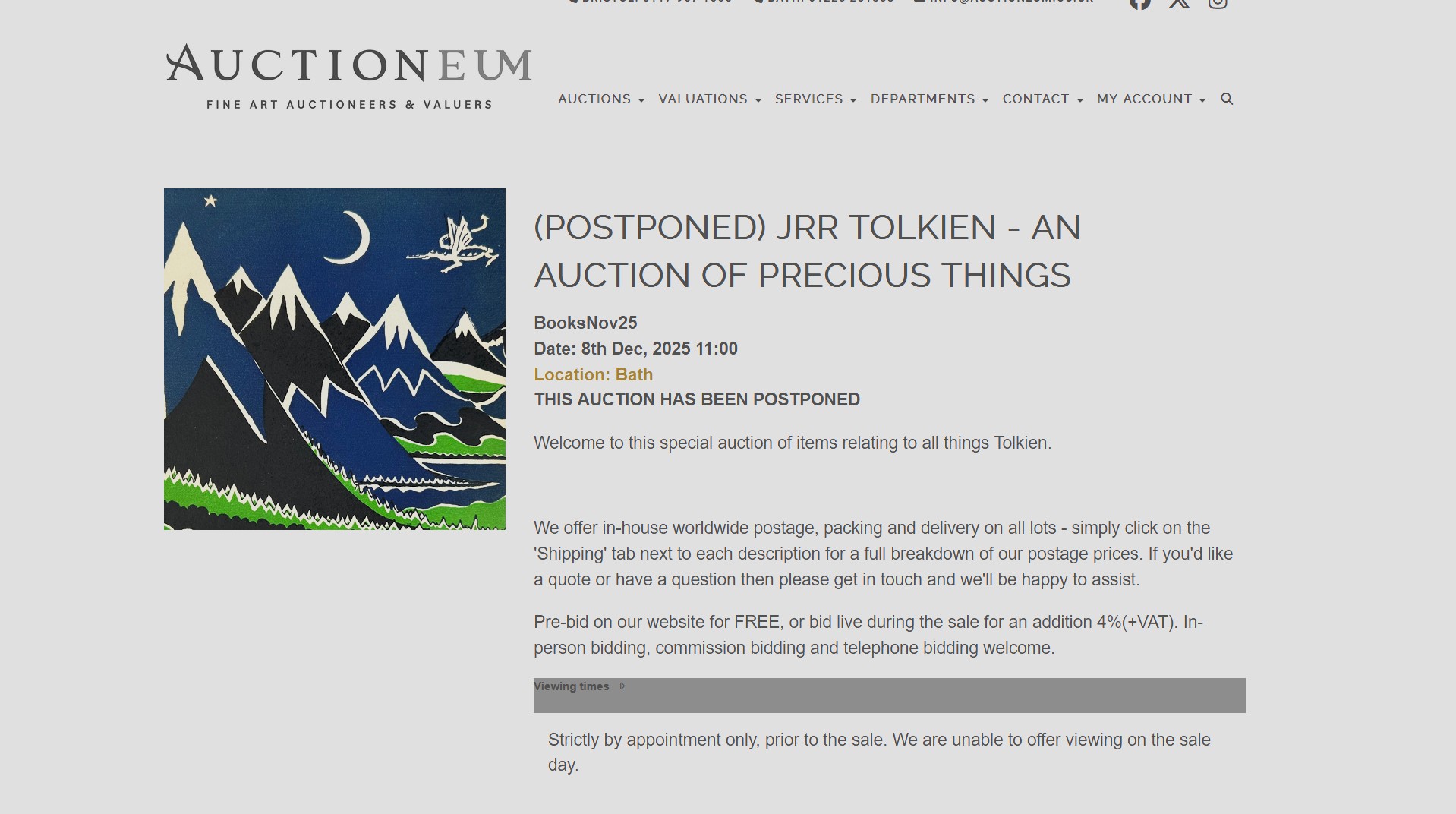
It is currently showing that the auction has been postponed. I wonder what the final result will be.



24 Nov, 2025
(edited)
2025-11-24 9:11:47 PM UTC
Edited by The late Stu on 2025-11-24 9:13:39 PM UTC
Edited by The late Stu on 2025-11-24 9:15:02 PM UTC
Edited by The late Stu on 2025-11-24 9:15:02 PM UTC
2025-11-24 9:11:47 PM UTC
Mr. Underhill wrote:
It’s good that we have a record of the items in question, in case they show up elsewhere.
Absolutely. I fully expect that these items -- and items just like them - will show up again. Hopefully this auction remains "postponed".
And to add, the strong threat/suggestion that anyone might be sued for calling the items here into question has left a very sour taste with me that won't be forgotten. All auctions and items for sale anywhere should be open to question, and some will be defended with evidence and shown true, some likely shown false (or unable to be shown true).
The late Stu wrote:
Mr. Underhill wrote:
It’s good that we have a record of the items in question, in case they show up elsewhere.
Absolutely. I fully expect that these items -- and items just like them - will show up again. Hopefully this auction remains "postponed".
And to add, the strong threat/suggestion that anyone might be sued for calling the items here into question has left a very sour taste with me that won't be forgotten. All auctions and items for sale anywhere should be open to question, and some will be defended with evidence and shown true, some likely shown false (or unable to be shown true).
Couldn’t have said it better myself, some in this discussion have opened themselves up to very close scrutiny in any and all future posts.

25 Nov, 2025
(edited)
2025-11-25 10:21:59 AM UTC
Edited by Tolkieniano on 2025-11-25 2:26:38 PM UTC
2025-11-25 10:21:59 AM UTC
I’ve learned of the postponement of the auction, and in the meantime I have received a reply from the auction house, which I am sharing as promised. It may help to clarify certain aspects.
The auction house explains that some key items — such as personal books, the case, and the pipe — come from a client who wishes to remain anonymous, which is standard practice. While only limited information can be published in the catalogue, they hold the full provenance details. The items were acquired by the client’s late relative and have remained in the same family for over sixty years, passed down through successive generations. They have confirmed that this relative knew J.R.F. Tolkien, that Tolkien was known to give such items away, and they have also consulted the Art Loss Register.
I’m sorry that someone has misunderstood my words about whether or not one may question the authenticity of the items in the auction. I wrote what I thought, and I stand by it: as a rule, I never express a judgment before having all the information. I said that one should be cautious in issuing verdicts, because this has happened in the past and, for those who experienced it (thankfully not me), it was not a pleasant time.
Obviously — though it is best that I state it explicitly — I have no connection or interest of any kind with the auction house.
The auction house explains that some key items — such as personal books, the case, and the pipe — come from a client who wishes to remain anonymous, which is standard practice. While only limited information can be published in the catalogue, they hold the full provenance details. The items were acquired by the client’s late relative and have remained in the same family for over sixty years, passed down through successive generations. They have confirmed that this relative knew J.R.F. Tolkien, that Tolkien was known to give such items away, and they have also consulted the Art Loss Register.
I’m sorry that someone has misunderstood my words about whether or not one may question the authenticity of the items in the auction. I wrote what I thought, and I stand by it: as a rule, I never express a judgment before having all the information. I said that one should be cautious in issuing verdicts, because this has happened in the past and, for those who experienced it (thankfully not me), it was not a pleasant time.
Obviously — though it is best that I state it explicitly — I have no connection or interest of any kind with the auction house.

.webp)
 14
14