



Books and other printed materials >> J.R.R. Tolkien and G.B. Smith, With Wind in our Ears a review and interview with Giuseppe Pezzini


J.R.R. Tolkien and G.B. Smith, With Wind in our Ears a review and interview with Giuseppe Pezzini
16 hours ago
2026-6-5 3:05:26 PM UTC
2026-6-5 3:05:26 PM UTC
J.R.R. Tolkien and G.B. Smith, With Wind in our Ears
A Tolkien Guide Review
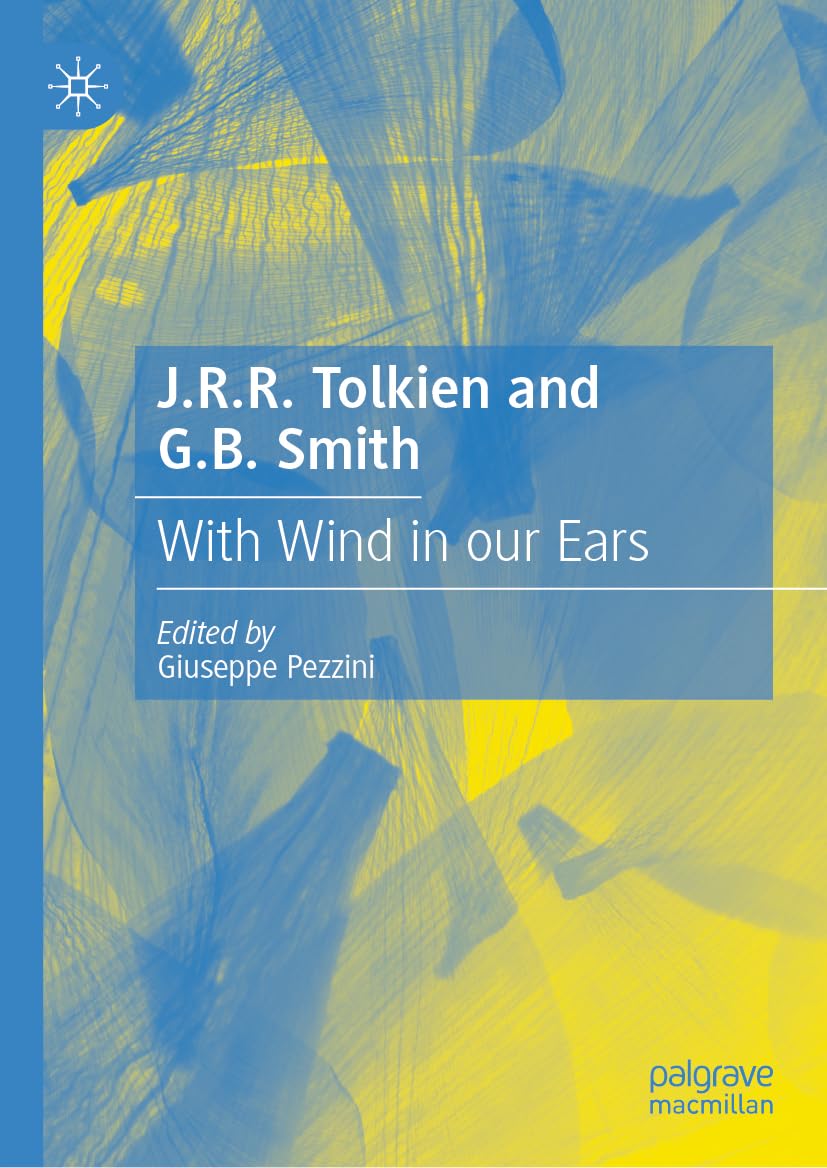
The following review is not intended to be an extensive assessment or blow-by-blow review of the book. For such posts we would suggest looking in time to Tolkien Studies, The Journal of Tolkien Research and other academic based journals and blogs. This review is intended for those wishing to judge whether the volume is a worthwhile addition to your collections and knowledge of the subjects covered in the volume.
When it was announced that Giuseppe Pezzini would soon edit and curate a collection of articles on the relationship between J.R.R. Tolkien and his fellow TCBSThe 'Tea Club, Barrovian Society'[1] member and close friend G.B. Smith, we were excited by the news. A study of the two friends if done well would be a very welcome volume. G.B. Smith's influence on Tolkien the poet cannot be understated, and his untimely death, less than two months after his twenty second birthday in December 1916 robbed Tolkien of one of his closest friends and someone he trusted with his own poetry, often replying on his friend to be blunt about that poetry. Although younger than Tolkien, Smith was already a gifted amateur poet and by February Smith could be quite hard on Tolkien when reviewing his friends poetry, but he was an admirer and believed that Tolkien was destined to be a published poet. Ironic it is indeed that, as Christina Scull and Wayne G. Hammond remark, it is "ironic that Tolkien survived the war but, until The Adventures of Tom Bombadil and Other Verses from the Red Book in 1962, had no published book of his poetry, while Smith was killed but fairly soon had a posthumous collection in print, A Spring Harvest."Collected Poems, p. xxvii[2]
So with the prospect of learning more about these two friends is an opportunity that one cannot pass up. The volume we review today has a lot to live up to, not least that hope of understanding more about Smith and Tolkien as friends, as admirers of each others poetry, but also because the names attached to this volume are all well known and successful in the field of Tolkien studies and beyond.See pp. xiii-xvii for a short summary of each of the contributors[3]
The introduction is as one would expect, a short overview of Tolkien and Smith and their relationship. As is observed in the introduction, "this volume is the first very of its kind dedicated to this topic, as well as, in fact, the very first comprehensive assessment of Smith’s poetry."
Please note that this short review is derived from a reading of a late proof, kindly provided by the editor and as such we will not include page numbers here until we have the physical book in hand.
Part I Life, Context, History
CHAPTER 1
‘A Perfect Genius’: G.B. Smith Among Family and Friends
CHAPTER 1
‘A Perfect Genius’: G.B. Smith Among Family and Friends
The first chapter ‘A Perfect Genius’: G.B. Smith Among Family and Friends by John Garth is as one would expect, informative, well researched and paints a realistic picture of Smith's life, his family roots and the world he grew up in. John Garth has had much to say about G.B. Smith over many years and his opening of this volume is very welcome.
Garth's use of Smith's poetry, especially examples not found in the posthumous selection from A Spring Harvest are especially welcome. In many cases they are published here after more than 110 years since the first and only publications in the King Edward School Chronicle.Thanks to the remarkable efforts of the staff at KES, much of their archives are digitized and freely available to read. See https://www.kingedwardvi-kes-archives.org/[4]
By the time Garth concludes his chapter on Smith's life to 1913, one could be forgiven for wanting this volume to continue as a biography of G.B. Smith written by John Garth. His knowledge of the young man and his precise manner of elevating Smith's life shows the respect and high-standing he holds for the young poet.
CHAPTER 2
Geoffrey Bache Smith at Oxford and at War: A Lost History?
Geoffrey Bache Smith at Oxford and at War: A Lost History?
Grace Khuri focuses on Smith's time at Oxford and draws much from periodicals from the period to show a confident and vibrant debater and speech giver at Oxford Union gatherings, and sobering, his change as his experiences of war took a toll on him. Khuri points to Tolkien's own reference to Smith's "grave face" and "grave voice" and it is brought home how war affected all of those in the middle of this most devastating period of our collective history. But Khuri also reflects on Smith's lighter side that remained, and the young man's humour that could not be dulled by war.
There is much to learn about the T.C.B.S. and Smith's affection for it and its members and Khuri's use of letters between him and Tolkien are especially welcome to this group. Giving crucial archival details, dates and quotes that are helping us better present information at our Guide to Tolkien's Letters.
Khuri introduces us to Smith as a university bod, and it is a pleasure to learn more about his activities and the interests he held. There is sadness, sadness that a young bright man could be like so many others beaten down by war. But the chapters ends with a poignant reminder that "Music, war, and loss were inexorably linked for those who died in and those who survived the Great War. Smith’s poems, to borrow a line from his Interlude, are truly
“songs that die not”."
CHAPTER 3
A Thousand Leaves from One Tree: The History of G. B. Smith’s Poetry
A Thousand Leaves from One Tree: The History of G. B. Smith’s Poetry
Setting out the aims of his chapter, Oronzo Cilli remarks that he "will first focus on a selection of poems that were published before their inclusion in A Spring Harvest (1918), discussing on textual differences with the later versions. I will then present and discuss five early reviews of his collection A Spring Harvest, two of which were probably authored by Tolkien himself..."
As one would expect from Cilli, the bibliographic record gains from corrections. He notes on Tolkien's prefatory remark in one example that "the third part [of a Spring Harvest] contains only poems written after the outbreak of the war". Pointing out that a poem, 'Dark is the World Our Father Left Us' was in fact written and published before the outbreak of war.
Cilli makes a claim in his chapter that two of the reviews are likely written by Tolkien himself. Noting that "the precise references to Tolkien’s “intervals of active service and of convalescence in hospital” during which the editorial work was accomplished seem to suggest that the author of the review was no one else than the editor of A Spring Harvest himself". One is not confident enough to support or dispute this claim outright, but some small textual references are worthy of note. Cilli rightly connects the review through details of Tolkien's recovery and his activities and the reproduction of the Times Literary Supplement review of July 18, 1918 has a short section that interested this reader. It says that "It is curious — and it is quite likely other readers may disagree — that to us the ‘last Poems’, at the end, written after the outbreak of war, seem to have lost something of the rare quality of the earlier pieces." One word can be argued to suggest a dual-authorship in that "us" could be literal, but it is especially noteworthy that Tolkien's error in his prefatory note is repeated in a sense in the review. The review notes that the "last poems" were written after the outbreak of war, and the contents list for A Spring Harvest gives part three as "III. Last Poems". Would a reviewer other than Tolkien or Wiseman pick up on this very minor note and reproduce it in a review? It seems unlikely. It is therefore that we believe Cilli has stumbled upon texts that very likely should be added to the bibliographic record for J.R.R. Tolkien, at least as likely by his own hand or at least with a friend.
Cilli presents a poem, 'New Year 1915' to close out his chapter and it is a poignant one written by Smith not long before he went to join the war efforts.
Part II Genres, Resonances, Criticism
CHAPTER 4
G.B. Smith and J.R.R. Tolkien: Two First World War Poets
CHAPTER 4
G.B. Smith and J.R.R. Tolkien: Two First World War Poets
Stuart D. Lee discusses in his chapter the war poetry of Smith and Tolkien. At the outset one must raise one important point. Lee says that "The dating for all his poems is often based on Tolkien's own notes which were applied retrospectively in later years and therefore open to debate." One cannot agree with this opinion. It is fairly well evidenced in Collected Poems that the dating of poems are not only taken from Tolkien's dates added later, but in most cases are based on material factors such as the paper used, the other poems, ink, typewriters and published dates. Of course Tolkien's dates are considered and sometimes accepted, but those dates are often questioned when other information is available. Lee also raises the very valid question about the dating of Smith's poetry by Tolkien (and Wiseman) when considering them for inclusion in A Spring Harvest.
Lee sets out his chapter with a brief but informative history of A Spring Harvest and moves rapidly to its publishing. As was noted earlier by Oronzo Cilli that Tolkien himself likely provided two reviews, Lee notes that the publisher Galloway Kyle did the same. He weighs this "stunt" against the advice to Tolkien from "R. W. Reynolds’ comment to Tolkien (2 August 1915) advising him to do whatever he could to get his poetry published as these were not ordinary times."
He then gives an entertaining and informative discussion on the war poetry of Smith, followed by a similar one on Tolkien's own war poetry.
CHAPTER 5
‘That we may do the things undone’: Smith, Tolkien, and the Classics
‘That we may do the things undone’: Smith, Tolkien, and the Classics
This chapter brings us to the editor of the volume, Guiseppe Pezzini's discussion of the "special relationship" between Tolkien and Smith. Pezzini looks at the reception to war poets, and especially the reaction and growth of research into "Tolkien and the Classics (2021-2025)" and "Classical Reception in Smith's Spring Harvest". It is only natural that across a limited number of pages these subjects cannot be studied in full, and helpfully we come away with a much longer reading list to enjoy at our leisure and a return to this and other chapters while reading those other works will surely benefit our knowledge of Tolkien and Smith's poetry. But while the Tolkien portion is short, highlighting larger volumes and articles, the section on Smith is of far greater scope and we learn much about his poems. The editors admiration for the final poem from Spring Harvest is evidenced in his section on 'The Burial of Sophocles' and its parallels with Earendel and Bilbo. A comparison is provided and we learn more on the connections between Smith and Tolkien's art.
Here as with all of the chapters, the reference to other volumes is impressive and welcome. The research is evident throughout and impressive.
CHAPTER 6
‘O scholar grey with quiet eyes’: G.B. Smith’s Poem Rime and Its Influence on Tolkien’s Work
‘O scholar grey with quiet eyes’: G.B. Smith’s Poem Rime and Its Influence on Tolkien’s Work
Mark Atherton's chapter feels more slight than the others, which is not to mean it is any less justified among the selection. Atherton asks a question at the outset, "Who is the “scholar grey with quiet eyes” in G. B. Smith’s poem Rime (ASH 3), working at his books in the turret chamber? Could this be a veiled reference to J. R. R. Tolkien, who, unlike his fellow T.C.B.S. member G. B. Smith, decided to finish his studies first before joining the army in 1915 and only then making his contribution to the war effort? Are we justified in reading Smith’s poem biographically in this way?"
This is the sole focus of the chapter and Atherton is for this reader convincing with his argument and conclusions.
CHAPTER 7
The Monk and the Bird’s Song: A Motif in Longfellow, Smith, and Tolkien
The Monk and the Bird’s Song: A Motif in Longfellow, Smith, and Tolkien
Kris Swank looks at the engagement by Smith and Tolkien with Longfellow's 'The Monk and the Bird's Song'. Especially on their use of his style and imagery. Demonstrating how Smith used and adapted Longfellow themes, and connecting Tolkien's own use not only within his own work on 'The Death of Saint Brendan' but also how he edited A Spring Havest with cues from Longfellow. Those interested in how poets are inspired by earlier names, this chapter will be of immense interest.
CHAPTER 8
From the ‘Dawns’ to the ‘Tides of Time’: Smith and Tolkien in the Mists of Glastonbury Legends
From the ‘Dawns’ to the ‘Tides of Time’: Smith and Tolkien in the Mists of Glastonbury Legends
Federica Calabrese focuses on two poems for her chapter. Smiths' 'Glastonbury' and Tolkien's 'Fall of Arthur', with specific reference to Tolkien's prefatory note to A Spring HarvestFound on page 196 of this volume.[5] to open. Her chapter discusses the thematic connections to Malory's Morte Arthure as well as the traditions from the area of the setting and the mythological sources found in each poem.
CHAPTER 9
G.B. Smith: Apprentice Poet of His Time
G.B. Smith: Apprentice Poet of His Time
Allan Turner focuses on Smith, the "apprentice poet" and asks how can a critical assessment be established. It is a fair question. As he remarks, Smith died young and published very little, his only published work being that edited by Tolkien. Turner notes that previous works on Smith have focused on Smith's relationship to various wider subjects, quite rightly. The war, the T.C.B.S., to Smith's relationship with Tolkien, and on. His focus on the poetry is very welcome and demonstrates the potential while not lingering on the wider considerations discussed previously.
EPILOGUE
CHAPTER 10
‘The T.C.B.S. was destined to testify for God and Truth’: Reflections on Tolkien’s Letter no. 5 to G.B. Smith
CHAPTER 10
‘The T.C.B.S. was destined to testify for God and Truth’: Reflections on Tolkien’s Letter no. 5 to G.B. Smith
Ivano Sassanelli looks at the relationship between the T.C.B.S., making reference to Carpenter's Letter #5 (J.R.R. Tolkien to G. B. Smith, 12 August 1916). Looking at the special friendship between these four young men who "desire to change the World through Poetry and Literature."
Perhaps little should be said of this final chapter as we each experience the relationship between Tolkien and his closest friends in different ways and Sassanelli offers us a fitting perspective to these beautiful relationships which were cut short by warfare. Drawing on the the editors own thoughts from his 2025 volume, Tolkien and the Mystery of Literary Creation, Sassanelli concludes on Tolkien's motivations, "to preserve and convey the mission and calling of the T.C.B.S. In both his Secondary World, and through its primary ideas on eucatastrophe and the relationship between Creation and sub-creation, Tolkien strove to ‘bear witness to God and Truth’."
Appendix
Little needs to said about the appendix other than it contains G.B. Smith's complete A Spring Harvest and with the examples found throughout this volume, it is the most expansive and detailed look to date on Smith's short career as a poet.
It was pleasing that Smith's poems have been assigned number references here and the hope is that future study adopts them. They were designed by the editor for referencing in this volume, but these work very well and would be a very handy tool for other volumes and papers that refer to it.
CONCLUSION
The chapters in this book represent a wide and varied look at Smith and Tolkien and through them the group that was the T.C.B.S. It is fitting that the volume treats more of Smith's poems than any work to date as well as opening up yet more study opportunities on Tolkien.
It has been a pleasure to read the book in review before publication and it remains for us to thank Beppe Pezzini for his immense efforts and for making time to chat to onthetrail about this new book (interview linked below) along with all of the contributors who gave their precious time to the volume. Our final hope is that this volume promotes and encourages more study into Smith's poetry and its connection.
Tolkien Guide
onthetrail had the pleasure of sitting down for a chat with Beppe Pezzini for a short talk about his work in Tolkien studies and about the new book.
FROM THE BACK COVER
Despite his discreet personality, private “vices", and literary idiosyncrasies, Tolkien was in fact a deeply collaborative figure, both as a scholar and, above all, as a writer. This volume is dedicated to one of his earliest and most significant creative and personal collaborations, his friendship with G.B. Smith: an alumnus of Corpus Christi College, Tolkien’s school friend and fellow member of the T.C.B.S., and indeed his closest companion during university years. A gifted poet, Smith published only one collection, A Spring Harvest, edited posthumously by Tolkien after Smith’s death in the trenches of the Somme – another lost voice among the First World War poets. The volume explores this relationship from biographical, literary, and philosophical perspectives, focusing on the content and style of Smith’s poetry, Tolkien’s editorial work, their shared intellectual world, and the lasting influence of Smith on Tolkien’s imagination. In doing so, it also seeks to give Smith his due, recognising A Spring Harvest not only as the premature culmination of his talent, but also as a body of work carried forward and fulfilled in the enduring legacy of his friend, J.R.R. Tolkien.
Typographical errors noted:
- p. 68 - challenge e around > challenge around
1 The 'Tea Club, Barrovian Society' ↩
2 Collected Poems, p. xxvii ↩
3 See pp. xiii-xvii for a short summary of each of the contributors ↩
4 Thanks to the remarkable efforts of the staff at KES, much of their archives are digitized and freely available to read. See https://www.kingedwardvi-kes-archives.org/ ↩
5 Found on page 196 of this volume. ↩



 3
3