




The Bovadium Fragments: TolkienGuide review
3 Oct, 2025
(edited)
2025-10-3 3:52:29 PM UTC
2025-10-3 3:52:29 PM UTC
THE BOVADIUM FRAGMENTS: A Review
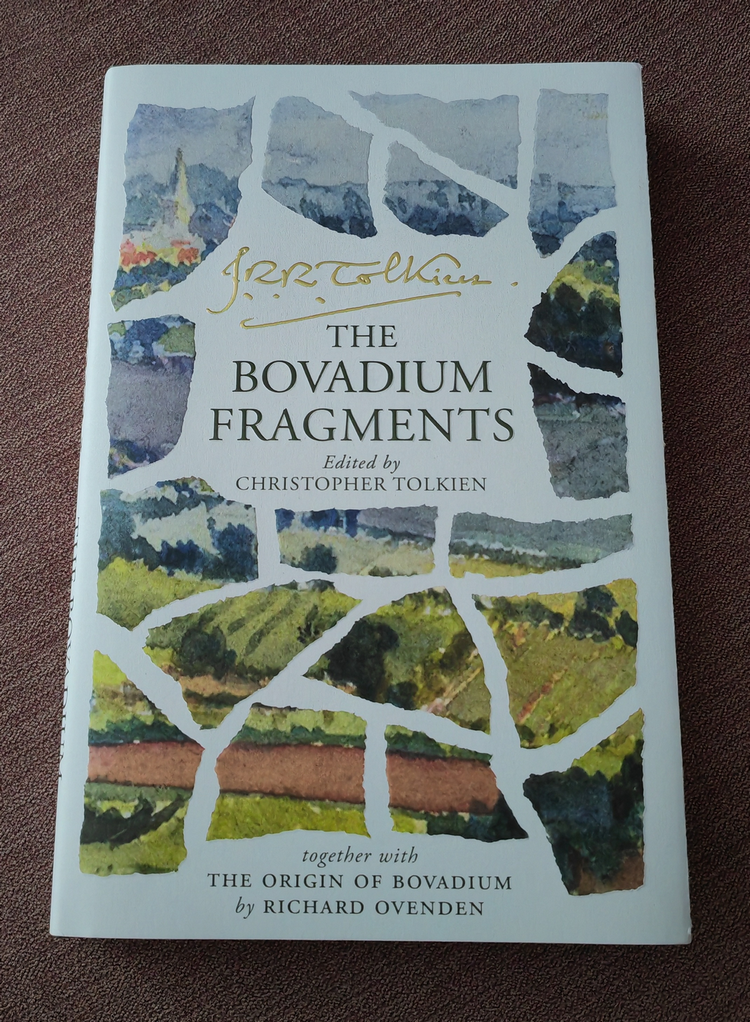
Jacket design by Emily Langford/HarperCollins Publishers Ltd
INTRODUCTION
Earlier this year it was announced by HarperCollins that they were due to publish for the first time "a previously unknownWhile we take the point that many readers will very likely not have heard of this story previously, it should be noted that it was not unknown. Mentioned in Biography, p. 163 Carpenter mentions the story, describing it as a "parable of the destruction of Oxford (Bovadium) by the motores manufactured by the Daemon of Vaccipratum (a reference to Lord Nuffield and his motor-works at Cowley) which block the streets, asphyxiate the inhabitants, and finally explode."[1] short satirical fantasy by J.R.R. Tolkien, edited by his son, Christopher Tolkien", reactions were mixed. It has become a tradition of sorts at such announcements to reintroduce the accusation that "HarperCollins are scraping the barrel". If by scraping the barrel it is intended to suggest that the publishers are releasing works by J.R.R. Tolkien which are not worthy of publication, read on for our review of the book to learn a little about its contents and whether we agree with that accusation.
The Bovadium Fragments, or The End of Bovadium as JRRT referred to it,Bovadium p. xiv and p. 110[2] was written, most likely, over a period from mid 1957 onwards but it appears to have gestated most effectively in c. 1960 when J.R.R. Tolkien wrote on 25 October of that year, via his secretary Elizabeth Lumsden, to Rayner UnwinBovadium p. xiii and Letter from Elizabeth Lumsden to Rayner Unwin • 25 October 1960 (#2603)[3] asking for the name of the editor of Time and Tide as "Tolkien wants to offer him a short piece he has written". Christopher Tolkien questions whether his father ever submitted it, and we have no details at this time to answer that question, but by 1966 Tolkien had given it to Clyde S. Kilby to read while they were working on his then then in progress Silmarillion. Kilby thought publication was difficult,Bovadium pp. xiv-xv[4] and by December 1968 Tolkien wrote a letter to Rayner Unwin on the matter, declaring that he had "‘no intention of publishing it now (if ever)". Letter from J.R.R. Tolkien to Rayner Unwin • 2 December 1968 (#2607)[5]
Tolkien's inspiration for Bovadium, a 1914 poem by A. D. Godley entitled The Motor Bushttps://en.wikipedia.org/wiki/The_Motor_Bus[6] , is included in the volume.Bovadium p. xvi[7] The inclusion of the poem is welcome touch by Christopher Tolkien. Tolkien had retained the poem with his typescript of the story inspired by it.Tolkien's Library, 2nd ed., p. 107, item 775[8] Christopher Tolkien gives some background on the material, its history, including a note to him, sent with the manuscript by his father. Letter from J.R.R. Tolkien to Christopher Tolkien • c. late 1960* (#2608)[9] Various details are given about the manuscripts and typescript and the material which Christopher Tolkien's edited for inclusion in the story.
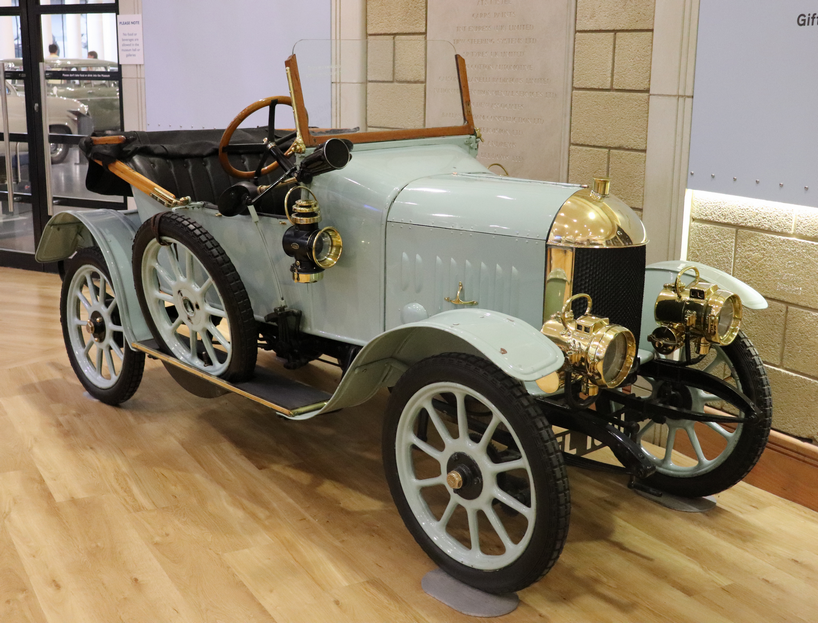
Oxford 2-seater 1913Vauxford, CC BY-SA 4.0 <https://creativecommons.org/licenses/by-sa/4.0>, via Wikimedia Commons[10]
Of course in the early 1920s, in post-war Britain, the nation saw an increase in the use of motor vehicles up and down the land. Tolkien would not have been a stranger to seeing adverts in academic journals and other printed magazines that he read and was published in and during his time at Leeds a new sales centre had opened and a car advert was included in The Gryphon (New Series, Volume 4, Number 3, December 1922). Coincidentally, Tolkien's 'The Clerke's Compleinte' was published in the same issue.https://digital.library.leeds.ac.uk/vi ... wspapers/The_Gryphon.html[11]
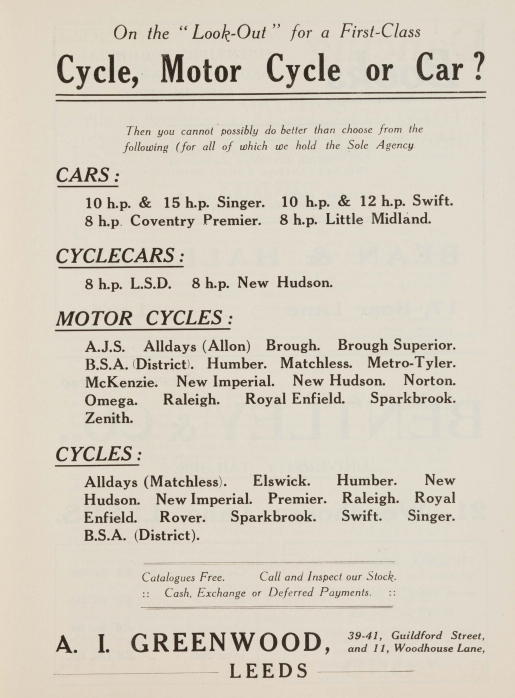
The Gryphon, Vol. 4, Issue. 3, Dec 1922https://digital.library.leeds.ac.uk/20477/[12]
There is no firm date for when Christopher Tolkien wrote his introduction, but some clues are offered. Referenced at various points is Wayne G. Hammond and Christina Scull's Companion and Guide and references are to the 2017 edition. Chris Smith in his publishers notep. xi[13] remarks that this is "Christopher Tolkien's final presentation" which could be taken to mean that it is the final work of his fathers to be presented in print edited by him, or that it was the final work he himself was engaged with. From private correspondence, we know that the manuscripts were deposited at the Bodleian in 1985 and in 2003 were redesignated to 'MSS Tolkien B 62', meaning that these papers were no longer available for research. In his interview with us (see link below), Richard Ovenden OBE notes that Christopher had shown him the manuscript during a visit to see him and Baillie. They were both working on their parts into of this well the 2010s.
THE BOVADIUM FRAGMENTS
The Bovadium Fragments is short and like some other Tolkien shorter works before it, Bovadium can be read in one short sitting. That fact however should not deter readers from it. Like so many of Tolkien's shorter works, Bovadium offers readers and researchers an interesting and entertaining look into the mind of a man who had the environment and encroaching modern world at the heart of some of his stories.
The following contains only very minor spoilers! Bovadium opens with an introduction by one Doctor Sarevelk (Klever as) and with an editorial note by Doctor Gums (Smug). In it are discussed a site of historical import, found at Vasti, and two languages, interestingly given designations of 'A' and 'B'. 'A' being that of Latin and 'B' of the vulgar (English) form.
The Fragments proper are split into three chapters with further texts (Other Texts of Fragments II) coming after a postscript by Doctor Gums.
Fragment I in Latin is not long, just three pages before a one page editorial note gives details on it.
Fragments II and III in English with Latin inserts tell the story, with much dramatic humour, of Bovadium (Oxford) and the invasion of "abominable machines" known as "Motores". The story pokes fun at people with motor vehicles and it has to be said that the humour applies to many of us who drive Motores in 2025.
The story told between these covers is fun, but it also demonstrates that Tolkien's issues with modern machinery was a subject he carried throughout his life, from childhood to his later years. He had long bemoaned the encroachment of the modern world, such as in 1938 in a letter to Miss Kilbride when he says that "Oxford is changing very fast and mostly (not wholly) for the worse. It's no longer a University Town. The old dialect is driven off the street..."See Letter from J.R.R. Tolkien to Miss Kilbride • 24 December 1938 (#110)[14]
It is in fragment II that on page 29 we find a previously unpublished illustration by Tolkien which is a nice extra to have. HarperCollins are clear that none of the illustrations in the book were created with the story in mind, but they have all been chosen sensitively and are a welcome addition to the book (See below for a list of artwork and where they are found). On the subject of the books artwork, it should also be remarked that it was a pleasant surprise to open the book and find two endpapers using ‘King’s Norton from Bilberry Hill’ which is also used as the front and rear cover. One might reasonably expect plain endpapers in a trade hardcover that is inexpensive but great pains have been taken with the design. There is a ribbon marker in the same dark green as the boards, and the paper while inexpensive is a pleasant off-white (cream) colour that is pleasing on the eye. The illustrations are on the same paper as the text and in this instance is the correct approach. The illustrations are inserted among the text and that works well to make the story feel more fleshed out. Whether an editorial decision by the editor, or the publisher, we do not know. Overall for a Trade hardcover, this short book feels remarkably well planned out and designed.
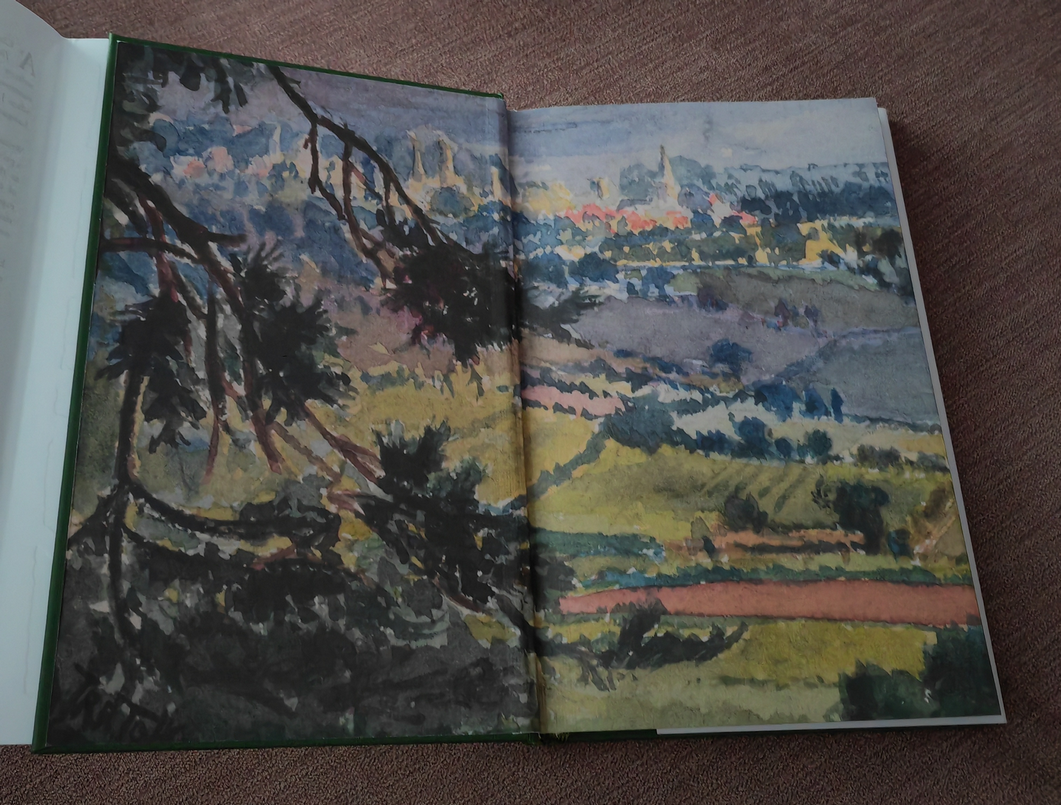
‘King’s Norton from Bilberry Hill’ J.R.R. Tolkien
'Other Texts of Fragments II' contains a poem "in thirty-one octosyllabic couplets" and a Latin text which is followed by a translation of it by Christopher Tolkien. One might think that we had been treated to so much poetry recently, with The Collected Poems, edited by Christina Scull and Wayne G. Hammond (Findegil) that no more substantial poems would remain to be published. If the editors of the recent three-volume box-set saw the this untitled poem, we do not know, but would welcome any elaboration if they are able. The poem, with its mention of "Iffley" makes one look back to the poem bearing that same name, 'From Iffley',See Collected Poems, pp. 54-6.[15] written from 1911 to c. ?1915. One can only wonder if Tolkien had his earlier poem in mind when he wrote this later text where Bovadium has surrendered itself to the dominance of the modern world and its endless stream of vehicles. Whether that might be the case or not, it is a stark change from the timelessness of the former to the smoke fumes of the 1960s.
This short story has been supplemented by an article, 'The Origin of Bovadium' by Richard Ovenden OBE. We feel it a very sensible choice to include an article rather than another story as Richard Ovenden's text places Tolkien in the time and environment to which readers have just been treated with his fragments. We learn more about Tolkien, Oxford and even the motor industry there. Interspersed with great photographs and maps, the article is a welcome addition and is well placed given Tolkien's mixture of academic structure and humour in the story. Some context to aid the reader is a very good choice. Presenting some previously unpublished texts in his article, such as a draft from Tolkien's lecture On Fairy Storiesp. 78[16] is the icing on the cake for readers and researchers who eagerly anticipate previously unpublished texts.
The Bovadium Fragments is a welcome title among Tolkien's ever growing posthumous publications for a number of reasons. We learn more about his humour, his attitude towards modernity, and we see his word-play delightfully as well as his continued ability to laugh at society in a fun way.
The accusation remarked on above that HarperCollins are scraping the barrel may be somewhat true. Any author who has been dead for many years and maintains a unique interest from readers requires the publication of fresh titles from time to time and this entry is a worthy one. If HarperCollins are scraping the barrel, then long may they scrape if The Bovadium Fragments is the result.
Always welcomed by the Scribes from the 'Guide to Tolkien's Letters', there are excerpts from and mentions to various letters and they can be seen using our tag Bovadium.
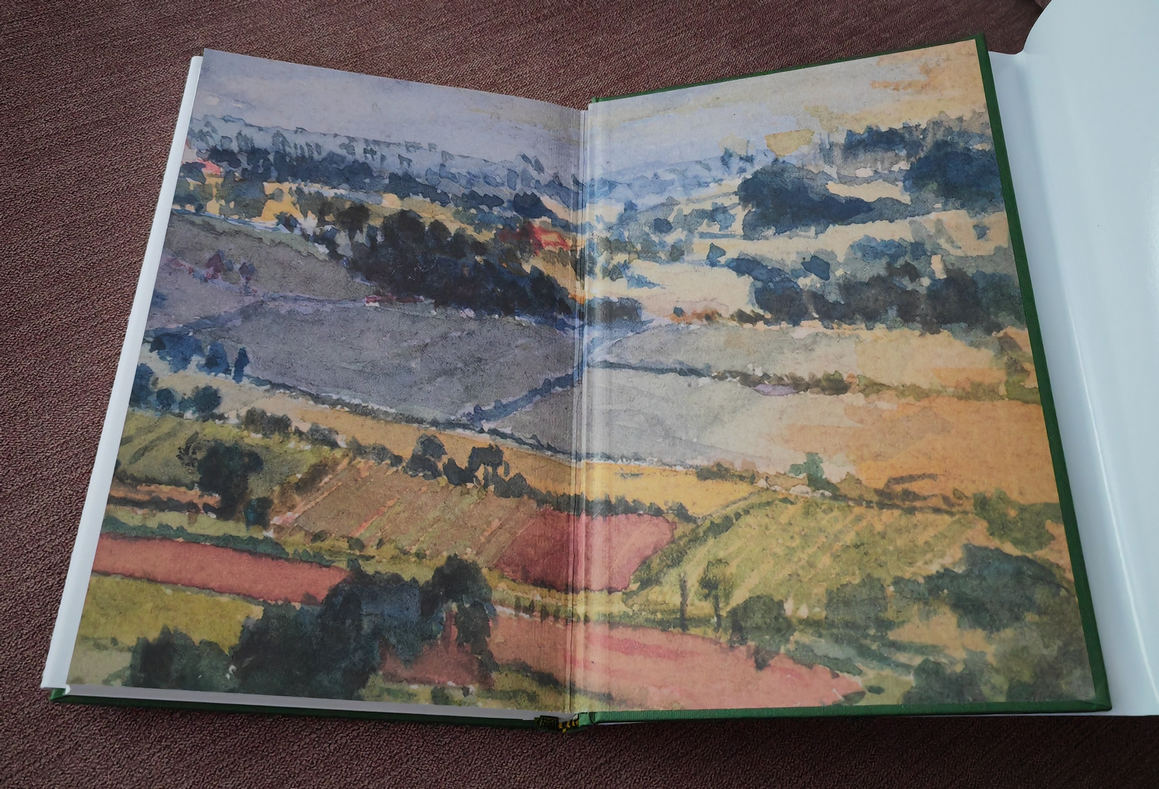
‘King’s Norton from Bilberry Hill’ J.R.R. Tolkien
IN CONCLUSION
While closing out his publisher's note, Chris Smith remarks that
Within its lines may be found a concern for the fragility of our natural world, a love of which that was shared by both father and son. As Christopher Tolkien’s final presentation of his father’s work, it is therefore perhaps fitting that The Bovadium Fragments should be their coda.
It is hard after reading the book to find disagreement with Chris Smith on that rather bittersweet statement. Found here among the wit, the clever and funny lines, is found a deeply personal statement by Tolkien that shows his concern for the world he loved that was being overtaken by the modern world.
If this truly is "Christopher Tolkien’s final presentation of his father’s work", then it remains to once again thank him for his decades long work, and to quietly reflect that through him we were all very lucky to have a guardian so dedicated to understanding, expanding, and sharing his fathers work with us. "it is ... fitting that The Bovadium Fragments should be their coda."
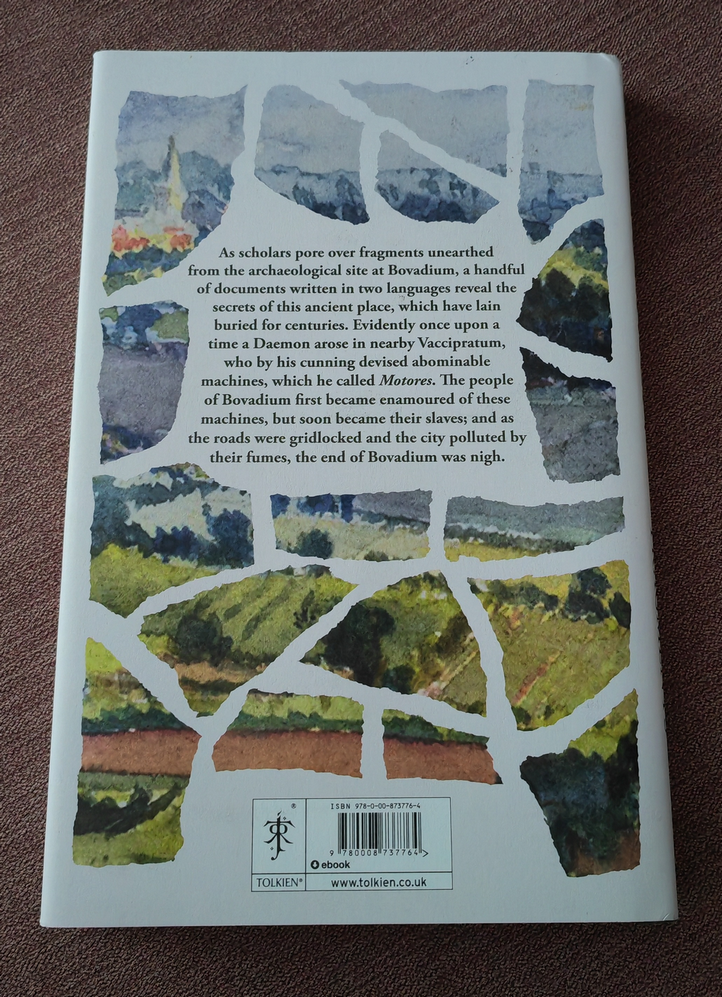
Jacket design by Emily Langford/HarperCollins Publishers Ltd
We extend our thanks to Chris Smith and Susanna Peden from HarperCollins for allowing us advance access to the book to review it for this website and to Richard Ovenden OBE for taking the time to talk with us about this book, his wider role in Tolkien studies and his work as a librarian. That interview is available on our YouTube channel.
CONTENTS
- Publisher’s Note
- Introduction
- THE BOVADIUM FRAGMENTS
- p. 3 Foreword
- p. 13 Fragment I
- p. 17 Fragment II
- p. 34 Fragment III
- p. 43 Postscript by the Editor
- p. 45 Other Texts of Fragment II
- THE ORIGIN OF BOVADIUM by Richard Ovenden OBE
- p. 124 Acknowledgements
ILLUSTRATIONS
- ‘London to Oxford through Berkshire’ reprinted from Tolkien: Maker of Middle-earth, p. 165, fig. 63
- ‘O to be in Oxford (North) now that Summer’s here’, first time published in colour. A black and white version is found in Artist & Illustrator, p. 29, fig. 25
- ‘Turl St., Oxford’ reprinted from Artist & Illustrator, p. 23, fig. 19
- Untitled [‘Alder by a Stream’] reprinted from Artist & Illustrator, p. 13, fig. 7
- ‘Broad Street, Oxford’ reprinted from Tolkien at Exeter College, John Garth, p. 28We mistakenly said that this illustration was previously unpublished. It has now been pointed out to us that this in fact not correct.[17]
- ‘King’s Norton from Bilberry Hill’ reprinted from Artist & Illustrator, p. 21, fig. 16. (this painting is also reproduced as front and rear endpapers)
- ‘The Wood at the World’s End’ reprinted from Artist & Illustrator, p. 63, fig. 60
WORKS CITED
Tolkien's Library, 2nd ed., Luna Press
J.R.R. Tolkien: Artist & Illustrator, HarperCollins, ed. Wayne G. Hammond & Christina Scull
Biography, George Allen and Unwin, Humphrey Carpenter
The J. R. R. Tolkien Companion and Guide, 2nd ed., (2017), see Chronology, p. 593, 707, 774, and Reader's Guide p. 347-8
UK
Publisher: HarperCollins (9 Oct. 2025)
Language: English
Hardcover: 144 pages
ISBN-13: 978-0008737764
Dimensions: 14.9 x 1.2 x 22.8 cm
UK eBook
US
Publisher: William Morrow (18 Nov. 2025)
Language: English
Hardcover: 144 pages
ISBN-13: 978-0063479081
US eBook
HarperCollins press announcement
World first publication of a previously unknown short satirical fantasy by J.R.R. Tolkien, edited by his son, Christopher Tolkien, and accompanied by illustrations from the author together with an essay, The Origin of Bovadium, by Richard Ovenden OBE.
As Christopher Tolkien notes in his Introduction, The Bovadium Fragments was a ‘satirical fantasy’ written by his father, which grew out of a planning controversy that erupted in Oxford in the late 1940s, when J.R.R. Tolkien was the Merton Professor of English Language and Literature.
Written initially for his own amusement, Tolkien’s tale was a private academic jest that poked gentle fun at such things as 'the pomposities of archaeologists' and 'the hideousness of college crockery'. However, it was at the same time expressing a barbed cri de coeur against the inexorable rise of motor transport and 'machine-worship' that was overwhelming the tranquillity of his beloved city.
Enriched by a selection of illustrations by the author, and enhanced by Christopher Tolkien's notes and commentary, readers can enjoy at last this tale of an imagined Oxford viewed through the lens of future (and not wholly reliable) academic study.
Richard Ovenden's accompanying essay paints a vivid portrait of Oxford during that time. He also provides rich background to the casus belli which led to the furore that Tolkien witnessed first-hand, as the embers of debate between town planners and the university colleges were fanned into flame.
Playful, erudite, and ultimately tragically moving, The Bovadium Fragments is like nothing else that J.R.R. Tolkien wrote, and its themes remain both provocative and timely. Within its lines may be found a concern for the fragility of our natural world, a love of which that was shared by both father and son. As Christopher Tolkien’s final presentation of his father’s work, it is therefore perhaps fitting that The Bovadium Fragments should be their coda.
1 While we take the point that many readers will very likely not have heard of this story previously, it should be noted that it was not unknown. Mentioned in Biography, p. 163 Carpenter mentions the story, describing it as a "parable of the destruction of Oxford (Bovadium) by the motores manufactured by the Daemon of Vaccipratum (a reference to Lord Nuffield and his motor-works at Cowley) which block the streets, asphyxiate the inhabitants, and finally explode." ↩
2 Bovadium p. xiv and p. 110 ↩
3 Bovadium p. xiii and Letter from Elizabeth Lumsden to Rayner Unwin • 25 October 1960 (#2603) ↩
4 Bovadium pp. xiv-xv ↩
7 Bovadium p. xvi ↩
8 Tolkien's Library, 2nd ed., p. 107, item 775 ↩
10 Vauxford, CC BY-SA 4.0 <https://creativecommons.org/licenses/by-sa/4.0>, via Wikimedia Commons ↩
13 p. xi ↩
15 See Collected Poems, pp. 54-6. ↩
16 p. 78 ↩
17 We mistakenly said that this illustration was previously unpublished. It has now been pointed out to us that this in fact not correct. ↩



 5
5